How Can I Hide My Projector Screen In My Living Room
Hiding your projector screen in the living room is easier than you think. Whether you prefer a retractable screen, a motorized drop-down option, or a clever furniture disguise, there are plenty of ways to keep your projector screen out of sight when you are not watching movies. These tips will help you create a living room setup that looks great and works even better.
Key Takeaways
- Retractable screens are the most popular and easy-to-use option for hiding your projector screen.
- Ceiling-mounted projectors keep everything hidden and save valuable floor and wall space.
- Furniture placement can cleverly disguise your screen without any special equipment.
- Motorized screens offer the ultimate convenience with remote control operation.
- Paint-on projector screens turn any wall into a hidden display surface.
- Ambient light rejection screens help you get a great picture even in bright rooms.
- Planning your layout early in your room design makes hiding your screen much easier.
📑 Table of Contents
- Why You Should Hide Your Projector Screen in the Living Room
- Best Ways to Hide a Projector Screen in Your Living Room
- Choosing the Right Screen Hiding Solution for Your Living Room
- Tips for a Clean and Seamless Look
- Common Mistakes to Avoid When Hiding Your Projector Screen
- Expert Tips for a Perfect Living Room Projector Setup
- Final Thoughts on Hiding Your Projector Screen
Why You Should Hide Your Projector Screen in the Living Room
Let us be honest. A big white projector screen hanging on your wall can look out of place during the day. It can make your living room feel like a home theater that never turns off. And let us be real, nobody wants that look all the time.
Hiding your projector screen keeps your living room looking stylish and welcoming. It also protects the screen from dust, pets, and accidental damage. When your screen is hidden, your room works harder for you every single day.
Plus, a clean and uncluttered space simply feels better. You get the best of both worlds. You enjoy a full cinematic experience when you want it, and you keep your room looking like a comfortable living space the rest of the time.
In this guide, we will walk you through every practical way to hide your projector screen. We will cover everything from budget-friendly tricks to high-end motorized solutions. By the end, you will know exactly what works best for your space and your style.
Best Ways to Hide a Projector Screen in Your Living Room
There are many creative and practical methods to conceal your projector screen. Each option has its own benefits, and the right choice depends on your room size, budget, and personal taste. Let us explore the top approaches.
Retractable and Motorized Screens
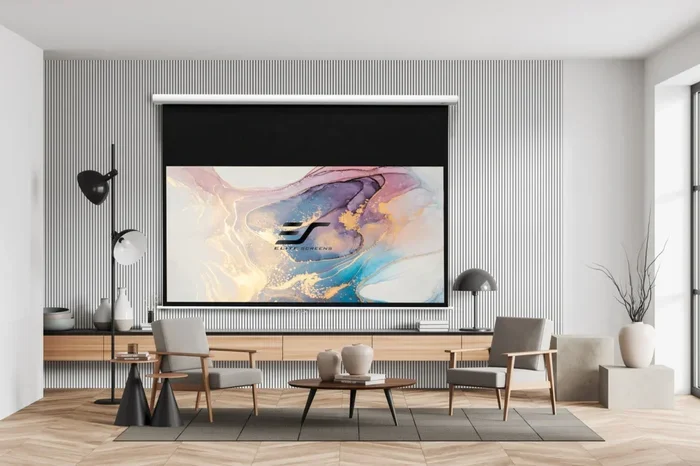
A retractable screen rolls up into a compact housing when not in use. This is hands down one of the most popular ways to hide a projector screen. You can mount it on the wall or the ceiling, and it stays completely out of sight when the movie is over.
Motorized screens take this one step further. With a simple push of a button, the screen drops down from its housing and rolls back up when you are done. Some models even work with smart home systems so you can control them with your voice.
Here are some key benefits of retractable and motorized screens:
- Clean look: The screen disappears completely when not in use.
- Easy operation: Motorized versions require zero effort.
- Space-saving: No bulky screen frame taking up wall space.
- Protection: The screen stays covered and dust-free.
- Multiple sizes: You can find options that fit any wall or ceiling.
If you want the most seamless solution, a motorized retractable screen is hard to beat. Brands like Elite Screens and Silver Ticket offer affordable options that look premium and perform well. You can also consider ambient light rejection screens that boost picture quality even in bright rooms.
Ceiling-Mounted Projectors with Hidden Screens
Another excellent approach is to mount both your projector and screen on the ceiling. This keeps everything completely hidden during the day. When you are ready to watch something, the projector turns on and the screen drops down from above.
This setup works especially well in rooms with high ceilings. It also frees up your walls for art, shelves, or other decor. If you have ever wondered whether you can mount my projector off center, the answer is yes. Off-center mounting gives you more flexibility in screen placement.
Here is what to consider with a ceiling-mounted setup:
- Ceiling height: Make sure your ceiling is tall enough for the screen to drop down without hitting furniture.
- Screen type: Use a manual or motorized ceiling drop screen for the cleanest look.
- Projector placement: A short-throw projector works best for ceiling mounting in smaller rooms.
- Wiring: Plan your cables carefully to keep them hidden inside the wall or ceiling.
This approach is perfect for dedicated home theater rooms or living rooms where you want a truly invisible setup. When the screen is up, the room looks completely normal.
Projector Screen Behind Furniture
If you do not want to invest in a retractable screen, you can use furniture to hide your setup. A large bookshelf, a sliding cabinet door, or even a curtain can effectively conceal your projector screen. This is one of the easiest and most budget-friendly methods available.
For example, you can mount your projector screen behind a set of sliding barn doors. When you want to watch a movie, you simply slide the doors open. When you are done, they close and the screen disappears. You can also use a large piece of furniture like an entertainment center with doors that close over the screen.
Furniture-based hiding has several advantages:
- Low cost: You likely already own suitable furniture or can find it cheaply.
- Flexible: You can change the setup whenever you want.
- Dual purpose: The furniture serves other functions in your room.
- No installation needed: Most methods require no drilling or mounting.
Just make sure the furniture is deep enough to fully cover the screen. A thin curtain might not block the screen completely, especially if there is light behind it. For the best results, use solid doors or deep shelving units.
Paint-On Projector Screens
A paint-on projector screen is a surprisingly effective way to hide your display surface. You paint a special projector screen paint onto any flat wall surface. When you are not using it, the wall simply looks like a normal wall. When you need it, you project onto the painted area.
This method works best in rooms where you do not have a dedicated wall for your screen. It is also a great option if you rent your home and cannot make permanent modifications. The paint creates a smooth, matte surface that enhances your image quality.
Here are some tips for using paint-on screens:
- Choose the right paint: Look for specialized projector screen paint like Screen Goo for the best results.
- Prep the wall: Sand and prime the wall before applying the paint for a smooth finish.
- Use a frame: A thin border around the painted area helps define the screen edges.
- Test the surface: Project onto the painted area before committing to the full wall.
One thing to keep in mind is that paint-on screens do not offer the same contrast as a dedicated white screen. They work best in rooms with controlled lighting. If your living room gets a lot of natural light, you might want to pair this with blackout curtains.
Choosing the Right Screen Hiding Solution for Your Living Room
Not every hiding method works for every room. Your choice depends on several factors, including your room size, budget, and how often you use your projector. Let us break down the decision-making process.
Consider Your Room Size
Small living rooms benefit from ceiling-mounted setups because they keep the screen above eye level and out of the way. Large living rooms give you more flexibility with wall-mounted retractable screens or furniture-based solutions.
If your living room doubles as a bedroom or a multi-purpose space, a retractable screen is your best bet. It disappears completely and lets the room serve other functions without any visual compromise.
Budget Considerations
Your budget plays a big role in choosing the right solution. Here is a quick comparison of the costs involved:
- Paint-on screen: $50 to $150 for paint and supplies.
- Curtain or fabric cover: $20 to $80 for a quality curtain rod and fabric.
- Furniture disguise: $100 to $500 depending on the piece you choose.
- Manual retractable screen: $100 to $300 for a good quality option.
- Motorized retractable screen: $300 to $1,500 depending on size and features.
- Ceiling drop screen with projector mount: $500 to $2,000 for a complete setup.
Even on a tight budget, you can achieve a great hidden screen setup. A simple curtain or a piece of furniture can make a huge difference without breaking the bank.
Aesthetic Preferences
Think about how important the visual appearance of your living room is to you. If you want the most invisible solution, go with a motorized retractable screen or a ceiling-mounted setup. If you are okay with a slightly visible setup, a paint-on screen or curtain can work well.
Also consider the overall style of your room. A modern living room with clean lines pairs well with a flush-mounted retractable screen. A more traditional room might benefit from a fabric curtain or a bookshelf disguise that blends with your existing decor.
Tips for a Clean and Seamless Look
Hiding your projector screen is only half the battle. You also want the room to look great when the screen is hidden. Here are some tips to make your setup look professional and polished.
Hide All Cables and Wires
Nothing ruins a clean look faster than visible cables running down the wall. Use in-wall cable channels or raceways to conceal all wiring. You can also run cables through the ceiling and down inside the wall for a completely invisible setup.
If in-wall wiring is not an option, use cable management boxes to bundle and hide cords. These come in various sizes and can blend with your wall color or decor. Keeping wires hidden makes a huge difference in how clean your room looks.
Match Your Screen Color to Your Wall
If you are using a fixed screen or a paint-on screen, choose a color that closely matches your wall. This makes the screen virtually invisible when the projector is off. Gray and off-white are the most common choices because they work well with most wall colors.
Use Ambient Light Control
Controlling the light in your room helps your projector perform better and keeps the screen area looking natural. Install blackout curtains or blinds on windows near your screen. This also helps when the projector is off because the area around the screen looks consistent with the rest of the room.
Keep the Projector Hidden Too
Remember that hiding just the screen is not enough. The projector itself can be a visual distraction if it is visible. Ceiling mounting keeps the projector completely out of sight. You can also place the projector inside a custom enclosure or behind furniture if ceiling mounting is not an option.
Some people worry about projector noise, but modern projectors are very quiet. If you are using a ceiling-mounted projector, the noise will not disturb your movie experience. And if you ever need to replace projector lamp with LED, many modern projectors now use LED technology that requires no lamp replacement at all.
Common Mistakes to Avoid When Hiding Your Projector Screen
Even with the best intentions, people make mistakes when trying to hide their projector screens. Here are some common pitfalls to watch out for.
- Choosing a screen that is too small: Make sure your hidden screen is large enough for comfortable viewing from your seating position.
- Ignoring ventilation: If you enclose your projector in a cabinet, make sure there is enough airflow to prevent overheating.
- Forgetting about throw distance: Your projector needs the right distance from the screen. Plan this before you hide anything.
- Using the wrong screen material: Not all surfaces work well for projection. A plain white wall will not give you the same quality as a proper screen surface.
- Neglecting the projector itself: A visible projector stick out like a sore thumb. Make sure your projector is hidden too.
- Overcomplicating the setup: The best hiding solution is one you will actually use every time. Keep it simple if needed.
Avoiding these mistakes saves you time, money, and frustration in the long run. Take the time to plan your setup carefully before making any purchases or installations.
Expert Tips for a Perfect Living Room Projector Setup
Once you have your screen hidden, you want to make sure the overall projector experience is top-notch. Here are some expert insights to elevate your setup.
Get the Right Projector for Your Space
The projector you choose matters just as much as how you hide the screen. For living rooms with some ambient light, look for a projector with high brightness (at least 2,000 lumens). For a truly immersive experience, consider a 4K projector that delivers stunning detail and clarity.
If you are using your projector for more than just movies, think about a model with good color accuracy and low input lag. This makes it versatile for gaming, presentations, and everyday viewing.
Use the Right Aspect Ratio
Most living room projectors work best with a 16:9 aspect ratio. This matches the shape of most modern TVs and gives you a wide, cinematic picture. If you plan to use your projector for gaming or computer use, make sure the aspect ratio matches your content.
Position Your Seating Correctly
The distance between your seating area and the screen affects your viewing comfort. A general rule is to sit about 1.5 to 2 times the diagonal screen size away from the projector. This gives you a comfortable viewing angle without eye strain.
Consider a Sound Upgrade
Projectors often have weak built-in speakers. To get the full cinematic experience, consider adding a soundbar or a simple speaker system. Your home theater setup is only as good as its audio as it is its video.
You can also use wireless speakers or a soundbar that blends with your room decor. This keeps the audio experience high quality while maintaining the clean look of your hidden screen setup.
Final Thoughts on Hiding Your Projector Screen
Hiding your projector screen in the living room is one of the best upgrades you can make for your home entertainment space. It keeps your room looking stylish, protects your equipment, and gives you the flexibility to enjoy a big-screen experience whenever you want.
Whether you choose a retractable screen, a ceiling-mounted setup, a furniture disguise, or a paint-on solution, the key is to plan ahead. Measure your space, consider your budget, and pick the method that fits your lifestyle best. With the right approach, your projector screen will be completely hidden when you need it to be and ready to go whenever you are in the mood for a movie night.
Take some time today to explore your options. Even small changes can transform your living room into a space that looks fantastic by day and delivers a stunning cinematic experience by night. Your projector deserves a home that works as hard as it does.
And if you are exploring other projector options, you might want to check whether you can use a projector instead of a TV for your everyday viewing needs. The right setup can truly change how you enjoy your living room.
Frequently Asked Questions
What is the cheapest way to hide a projector screen in a living room?
The cheapest option is to use a curtain or a piece of fabric to cover the screen when not in use. You can also use a paint-on projector screen, which costs around $50 to $150 in supplies. Both methods are budget-friendly and require no special equipment.
Can I hide my projector screen behind a TV stand?
Yes, you can hide your projector screen behind a TV stand or entertainment center. Make sure the furniture is deep enough to fully cover the screen. Also ensure there is enough space for the screen to deploy without hitting the furniture.
Do motorized projector screens work well in living rooms?
Motorized projector screens work excellently in living rooms. They offer smooth, quiet operation and can be controlled with a remote or even a smart home system. They are the most convenient option for hiding your screen quickly and easily.
How do I hide projector cables in my living room?
You can hide projector cables by running them inside the wall using in-wall cable channels. If that is not possible, use cable management boxes or raceways that blend with your wall color. Ceiling-mounted projectors make cable hiding easier since the wires can run straight down inside the wall.
Will a paint-on projector screen damage my wall?
No, paint-on projector screen paint does not damage your wall. It applies just like regular paint and can be removed with effort if needed. However, it is best to apply it to a primed surface for the smoothest and most durable finish.
What size projector screen should I use in a small living room?
For a small living room, a 80 to 100-inch screen is usually ideal. This gives you a big picture without overwhelming the space. Measure your viewing distance and choose a screen size that keeps the projector at a comfortable distance from your seating area.