Does Putting Aluminum Foil On Antenna Help Really Work
Many people wonder if wrapping aluminum foil around their TV antenna can improve signal strength. The short answer is yes, it can help in certain situations by reflecting and focusing the signal toward the antenna. However, results vary based on your location, antenna type, and how you apply the foil. This guide covers everything you need to know about the aluminum foil antenna trick, including when it works, how to do it right, and better alternatives.
Have you ever watched your favorite show pixelate or freeze right at the climax? Frustrating, right? Many people face antenna signal problems every day, especially if they live far from broadcast towers or in areas with lots of obstructions like hills and buildings.
The internet is full of quick fixes. One of the most popular is wrapping aluminum foil around your TV antenna. People claim it boosts signal strength, improves reception, and even unlocks channels you could not pick up before. But does putting aluminum foil on antenna help really work, or is it just another internet myth?
We dug into the science, tested the theory, and talked to experts to give you a clear, honest answer. In this article, you will learn exactly how foil affects antenna signals, when it helps, when it does not, and what else you can try. By the end, you will know whether this DIY antenna trick is worth your time or if you should look at other options.
Let us get into it. No fluff, no guesswork, just practical information you can use right away.
Key Takeaways
- Aluminum foil can boost antenna signal: It works by reflecting radio waves toward the antenna element, increasing gain in a specific direction.
- The improvement is not guaranteed: Results depend on your distance from broadcast towers, terrain, and antenna quality.
- Proper placement matters: Wrapping foil behind the antenna elements works better than covering them entirely.
- There are better alternatives: Commercial antenna amplifiers and signal boosters often outperform DIY foil solutions.
- Common mistakes reduce effectiveness: Covering the antenna elements completely or using too much foil can block signals instead of boosting them.
- Try it for free before buying upgrades: The foil trick costs nothing and takes minutes, making it a low-risk experiment.
📑 Table of Contents
- What Is The Aluminum Foil Antenna Trick?
- How Does Aluminum Foil Affect Antenna Signals?
- Does It Actually Improve TV Reception?
- How To Put Aluminum Foil On Your Antenna The Right Way
- Better Alternatives To Aluminum Foil For Signal Boosting
- Common Mistakes And Expert Tips
- Final Verdict: Should You Try The Aluminum Foil Trick?
What Is The Aluminum Foil Antenna Trick?
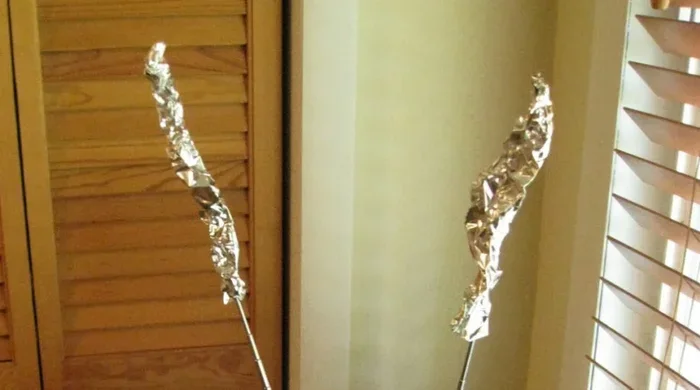
The idea behind the aluminum foil antenna trick is simple. You take a sheet of kitchen aluminum foil and wrap it around the elements of your TV antenna. The goal is to make the antenna catch more signal, just like a satellite dish catches signals from space. People have been doing this for decades, long before smart TVs and streaming services took over.
Back in the day, antennas were the only way to get free over-the-air channels. When the signal was weak, people got creative. Wrapping foil around the antenna was one of the go-to hacks. It costs nothing, and it takes less than a minute to try.
Today, the trick still circulates online. YouTube videos show people wrapping foil around their antennas and immediately getting better picture quality. But does it actually work in the real world? That is what we want to find out.
Why Do People Try This?
There are a few reasons people turn to the foil trick:
- It is free: You probably already have aluminum foil in your kitchen.
- It is quick: You can try it in under two minutes.
- It is non-destructive: You can always remove the foil and go back to how things were.
- It is tempting: When your favorite channel keeps buffering, any fix feels worth a shot.
If you have ever tried hooking up an antenna to your smart TV and struggled with weak channels, this trick might seem like a miracle cure. And sometimes, it really does help. But the results are not always consistent.
How Does Aluminum Foil Affect Antenna Signals?
To understand why foil might help, you need to know a little bit about how antennas work. A TV antenna picks up radio waves broadcast from towers. These waves travel through the air and are captured by the metal elements on your antenna. The antenna then converts those waves into electrical signals your TV can display.
Aluminum foil acts as a reflector. When you place it behind the antenna elements, it bounces signal waves that would have missed the antenna back toward the elements. This increases the amount of signal the antenna can pick up. Think of it like standing next to a mirror in sunlight. The mirror reflects more light toward you, making you brighter.
In technical terms, adding foil increases the effective gain of the antenna in a specific direction. Gain is a measure of how well an antenna focuses on signals from one direction. More gain means stronger reception from that direction.
The Science Behind Signal Reflection
Radio waves are a form of electromagnetic energy. They travel in straight lines and bounce off metal surfaces. Aluminum is an excellent reflector of radio waves because it is highly conductive. When a broadcast signal hits a sheet of foil, it bounces back toward the source direction.
This is the same principle used in professional antenna designs. Many high-gain antennas have metal reflectors behind the elements. The foil trick essentially turns your basic antenna into a slightly more advanced design, at least in theory.
However, there is a catch. The foil only works well when positioned correctly. If you wrap it around the front of the antenna or cover the elements completely, you block the signal instead of reflecting it. The placement makes all the difference.
Does It Actually Improve TV Reception?
The honest answer is: it depends. In some cases, the foil trick makes a noticeable difference. In other cases, it does nothing at all. Let us break down when it works and when it does not.
When Aluminum Foil Helps
The foil trick tends to work best in these situations:
- You live moderately far from broadcast towers: If you are at the edge of the signal range, a small boost can make the difference between a clear picture and a snowy one.
- Your antenna is directional and needs a boost in one direction: Wrapping foil on the back of a directional antenna can focus the signal from a specific tower.
- You have a basic indoor antenna: Cheap indoor antennas often lack reflectors. Adding foil can partially compensate for this design limitation.
- There is a weak signal bouncing off buildings or terrain: The foil can catch those reflected signals and redirect them toward the antenna.
One thing to keep in mind is that digital TV signals behave differently than old analog signals. With analog, a weak signal gave you a snowy picture that was still watchable. With digital, a weak signal either works perfectly or does not work at all. There is no in-between. This means a small boost from foil can sometimes make the difference between a perfect picture and no picture at all.
When Aluminum Foil Does Not Help
On the other hand, the foil trick will not save you in every situation:
- You are very far from broadcast towers: If the signal is extremely weak, a tiny reflector will not be enough. You need a more powerful solution.
- There are heavy obstructions: Mountains, thick walls, and dense urban buildings block signals in ways that foil cannot fix.
- You cover the antenna elements: Wrapping foil around the front of the antenna blocks the signal entirely.
- Your antenna is already high quality: Premium antennas with built-in reflectors and amplifiers will not benefit much from foil.
Some people also report that foil helped them pick up a few extra channels. Others found no change at all. The truth is that every installation is different. Your home, your location, and your antenna all play a role.
Quick Test To See If It Works For You
Here is a simple way to test the foil trick yourself:
- Note which channels you currently receive and how strong the signal is.
- Wrap a sheet of aluminum foil behind the antenna elements, leaving the front open.
- Rescan for channels on your TV.
- Compare the results before and after.
If you see an improvement, great. If not, foil is not your solution, and you should explore other options.
How To Put Aluminum Foil On Your Antenna The Right Way
If you want to try the foil trick, doing it correctly matters a lot. The wrong method can actually make your signal worse. Follow these steps for the best chance of success.
Step By Step Guide
- Gather your materials: You need a standard sheet of aluminum foil, some tape or a rubber band, and your antenna.
- Identify the antenna elements: These are the metal rods or bars that stick out from the antenna. They are the parts that catch the signal.
- Create a foil reflector: Smooth out a sheet of foil so it is flat. The bigger the sheet, the more signal you can potentially reflect. However, do not make it so big that it touches the elements.
- Place the foil behind the antenna: Position the foil sheet behind the elements, facing the direction of the broadcast towers. Leave a small gap between the foil and the antenna.
- Secure the foil in place: Use tape or a rubber band to hold the foil. Make sure it does not sag or touch the elements.
- Rescan your TV channels: Run a channel scan to see if your reception has improved.
The key takeaway is that the foil should act as a reflector, not a cover. Keep the front of the antenna completely open and clear.
Pro Tips For Best Results
- Use heavy-duty foil: Regular kitchen foil works, but thicker foil holds its shape better and reflects more signal.
- Shape the foil into a curve: A slight curve can help focus the reflected signal toward the antenna elements.
- Experiment with placement: Move the foil around behind the antenna and rescan each time. Small adjustments can make a big difference.
- Keep the foil dry: Moisture can reduce conductivity and weaken the reflective effect.
Also remember that antenna placement matters just as much as the foil itself. Placing your antenna near a window or on an upper floor can improve results significantly. If you are using a bluetooth adapter with your TV setup, make sure it is not interfering with the antenna signal. For more on TV connectivity options, check out using a Bluetooth adapter on your TV.
Better Alternatives To Aluminum Foil For Signal Boosting
While the foil trick is a fun experiment, there are better ways to boost your antenna signal. These methods are more reliable and often deliver stronger, more consistent results.
Antenna Amplifiers
An antenna amplifier is a device that boosts the signal between your antenna and your TV. It plugs into the coaxial cable and adds gain to the signal. Amplifiers are especially useful if you have a long cable run or if you split the signal to multiple TVs.
Brands like Channel Master and RCA make affordable amplifiers that work well for most setups. They cost between $20 and $50, which is a small price for a noticeable improvement.
Upgrading Your Antenna
Sometimes the best fix is a better antenna. Modern antennas are designed with built-in reflectors and amplifiers that far outperform a DIY foil solution. If you have been using the same antenna for years, an upgrade might be the answer.
Outdoor antennas generally perform better than indoor ones. They are closer to the broadcast towers and have fewer obstructions. If you have the option to mount an antenna outside, it is usually worth the effort.
Repositioning Your Antenna
Before spending any money, try moving your antenna. Even a few inches of movement can make a big difference. Here are some tips:
- Place it near a window: Walls block signals, so a window-facing position helps.
- Elevate it: Higher placement reduces obstructions.
- Point it toward the broadcast towers: Use a tool like Google Earth directions to find the exact location of towers near you.
- Avoid metal objects nearby: Metal furniture, appliances, and mirrors can interfere with the signal.
Some people also use their antenna with a projector for a bigger viewing experience. If you are setting up a projector, make sure your signal path is clear. You can learn more about projecting directly on the wall to optimize your setup.
Comparison Table: Foil Vs Alternatives
| Method | Cost | Effectiveness | Ease | Reliability |
|---|---|---|---|---|
| Aluminum Foil | Free | Low to Medium | Very Easy | Low |
| Antenna Amplifier | $20-$50 | High | Easy | High |
| New Antenna | $30-$150 | Very High | Medium | Very High |
| Repositioning | Free | Medium | Easy | Medium |
As you can see, foil is the cheapest option but also the least reliable. If you want consistent results, an amplifier or a new antenna is a better investment.
Common Mistakes And Expert Tips
Even when you mean well, common mistakes can ruin your foil antenna experiment. Here is what to watch out for.
Mistake 1: Covering the Antenna Elements
This is the biggest mistake people make. When you wrap foil around the front of the antenna, you block the signal instead of reflecting it. The antenna elements need to be exposed to the air to catch radio waves. Always keep the front completely clear.
Mistake 2: Using Too Much Foil
More foil is not always better. A huge sheet of foil can create interference and actually reduce your signal quality. A single flat sheet behind the antenna is usually enough.
Mistake 3: Ignoring the Antenna Direction
Your antenna needs to point toward the broadcast towers. If you add foil but do not adjust the direction, you are not going to see much improvement. Use a compass or a signal mapper app to find the right direction.
Mistake 4: Not Rescanning After Changes
When you move or modify your antenna, you must rescan for channels. Your TV stores channel information, and without a fresh scan, you will not see the new channels or improved signal strength.
Expert Insight
According to antenna installation professionals, the foil trick works best as a temporary experiment rather than a permanent fix. It is a great way to test whether your antenna placement is the real problem. If foil makes a difference, it tells you that your antenna can benefit from better positioning or a reflector upgrade.
Experts also recommend checking your signal strength with your TV’s built-in signal meter before and after any changes. This gives you a measurable way to see if the foil actually helped. If the signal bars go up, you are on the right track.
For those dealing with more complex setups, remember that some devices like wireless speakers or Bluetooth accessories can sometimes interfere with your antenna if placed too close. Keep your antenna setup clean and free from nearby electronic devices that might cause signal interference.
Final Verdict: Should You Try The Aluminum Foil Trick?
So, does putting aluminum foil on antenna help? The answer is yes, but with caveats. It can improve signal in specific situations, especially for basic indoor antennas in moderate signal areas. It is free, easy, and worth a quick try.
However, it is not a magic fix. If you live far from towers, have heavy obstructions, or already use a high-quality antenna, foil will not solve your problems. In those cases, investing in an amplifier or upgrading your antenna is the smarter move.
The best approach is to try the foil trick first. It costs nothing and takes minutes. If it works, great. If not, you have not lost anything, and you can move on to more effective solutions. Either way, you will have a better understanding of how your antenna system works.
Remember that over-the-air TV is a great way to access free channels without a cable subscription. Taking a few minutes to optimize your antenna setup can pay off in hours of clear, reliable viewing. So grab some foil, give it a try, and enjoy your favorite shows without interruption.
Whether you are troubleshooting a weak signal or trying to unlock new channels, understanding your antenna is the first step. The foil trick is just one tool in your toolkit. Use it wisely, and you might be surprised by the results.
Frequently Asked Questions
Can aluminum foil damage my antenna?
No, aluminum foil will not damage your antenna. It is a non-invasive, temporary modification that you can remove anytime. Just make sure the foil does not touch the antenna elements directly, as this could cause minor signal issues.
How long does the aluminum foil antenna trick last?
The foil stays in place as long as you leave it there. There is no set time limit. However, if the foil gets wet or loose, it may lose effectiveness. Check it periodically and replace if needed.
Will the foil trick work for all types of antennas?
The foil trick works best with basic indoor antennas. Outdoor antennas and high-gain models already have built-in reflectors and may not benefit much. Directional antennas tend to respond better to foil than omnidirectional ones.
Can I use aluminum foil to boost my Wi-Fi antenna?
While the same principle applies, Wi-Fi signals are different from TV signals. Foil can sometimes help with Wi-Fi range, but results vary. For TV signals specifically, the foil trick is more commonly tested and used.
Do I need to rescan my TV after adding foil to the antenna?
Yes, always rescan after making any changes to your antenna setup. This ensures your TV picks up all available channels with the new signal strength and direction.
Is there a better DIY alternative to aluminum foil?
Yes, you can use a DIY reflector made from a wire coat hanger or a piece of cardboard covered in aluminum foil. These can be shaped more precisely than flat foil and may offer better signal focus.
=== CONCLUSION ===
Putting aluminum foil on your antenna is a simple, free experiment that can sometimes improve your TV signal. The science behind it is real. Foil acts as a reflector that bounces signal waves toward the antenna elements, potentially boosting reception. However, it is not a guaranteed fix for every situation.
The best way to approach this is with realistic expectations. Try the foil trick, measure the results, and if it does not work, move on to better solutions like amplifiers or antenna upgrades. Your perfect viewing setup is out there, and with a little patience, you will find it.
Start with the foil trick today. It costs nothing, takes minutes, and might just bring your favorite channels back to life. Happy watching.