Can UWB Penetrate Walls Heres What You Need to Know
UWB technology uses low-power radio waves to communicate, but its ability to penetrate walls depends on several factors. While UWB can pass through thin materials like drywall and wood, it struggles with thick concrete and metal barriers. Understanding how UWB signal penetration works helps you make better decisions about smart home devices, indoor tracking, and IoT applications.
This is a comprehensive guide about Can Uwb Penetrate Walls.
Key Takeaways
- UWB signals can partially penetrate walls but lose strength depending on the material.
- Thin materials like drywall and wood allow UWB signals to pass through more easily than concrete or metal.
- Signal attenuation is the main challenge when UWB tries to pass through dense building materials.
- Apple AirTag and other UWB devices use clever workarounds to maintain tracking accuracy indoors.
- Frequency band and bandwidth play a huge role in how well UWB performs through obstacles.
- Through-wall detection is possible with the right UWB setup and antenna configuration.
- Indoor positioning accuracy remains one of UWB’s strongest advantages, even with wall interference.
[FEATURED_IMAGE_PLACEHOLDER]
Can UWB Penetrate Walls? Heres What You Need to Know
If you have ever wondered whether UWB can penetrate walls, you are not alone. Ultra-wideband technology has exploded in popularity thanks to devices like Apple AirTag and smart home trackers. But how well does it actually work when there is a wall in the way?
The short answer is yes, but with limitations. UWB signals can pass through many common building materials, though they lose strength along the way. This guide breaks down everything you need to know about UWB wall penetration, from the science behind it to real-world performance in your home or office.
Whether you are setting up a smart home, exploring indoor tracking, or just curious about wireless technology, this article covers it all. Let us dive in.
What Is UWB Technology and How Does It Work?
Ultra-wideband is a wireless communication technology that uses a very wide frequency band to send data. Unlike Bluetooth or Wi-Fi, which operate on narrow frequency ranges, UWB spreads its signal across a huge chunk of the radio spectrum. This gives it some unique advantages.
UWB sends out very short pulses of energy at precise times. By measuring how long these pulses take to travel between devices, it can calculate distance with incredible accuracy. This is called time-of-flight measurement, and it is the foundation of UWB location tracking.
Why UWB Stands Out from Other Wireless Technologies
Most wireless technologies rely on signal strength to estimate distance. This approach is prone to errors caused by walls, furniture, and other obstacles. UWB takes a different path. It uses time-based measurements, which are far less affected by signal attenuation caused by physical barriers.
Here is a quick comparison of how UWB stacks up against other common wireless technologies:
- Bluetooth: Uses signal strength for proximity estimation. Accuracy is around 1 to 5 meters.
- Wi-Fi: Also relies on signal strength. Accuracy ranges from 3 to 15 meters indoors.
- UWB: Uses time-of-flight for precision tracking. Accuracy can reach within 10 centimeters.
- RFID: Short-range and fast, but limited in spatial awareness and range.
This precision is why UWB location tracking has become so valuable for finding lost items, securing access control, and enabling advanced indoor positioning systems.
The Science Behind UWB Signal Penetration
Now let us get into the real question: can UWB signals pass through walls? The answer involves some physics, but I will keep it simple.
Every radio signal loses energy when it hits a solid object. This energy loss is called signal attenuation. How much attenuation occurs depends on three main factors: the frequency of the signal, the material the signal hits, and the thickness of that material.
Frequency Band and Wavelength
UWB operates in the frequency range of 3.1 GHz to 10.6 GHz. These are relatively high frequencies, which means the wavelengths are short. Shorter wavelengths tend to interact more with solid objects, which can reduce penetration ability compared to lower-frequency signals like those used in Bluetooth.
However, UWB compensates for this with its low power spectral density. The signal spreads its energy across a wide band, which helps it maintain enough strength to be detected even after passing through obstacles.
How Building Materials Affect UWB Signals
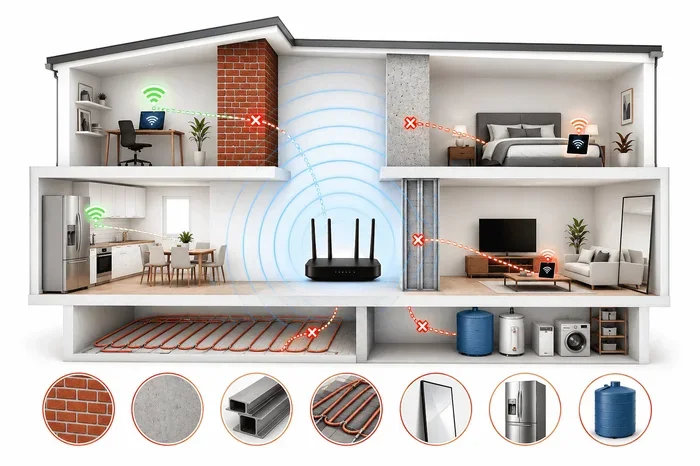
Not all walls are created equal. Here is how different common building materials affect UWB signal penetration:
- Drywall: Thin drywall is one of the easiest materials for UWB to pass through. Signal loss is minimal.
- Wood: Wooden studs and plywood panels cause moderate attenuation. UWB can still work through standard wooden walls.
- Glass: Glass has very little impact on UWB signals. Windows are usually not a problem at all.
- Concrete: This is where things get tough. Concrete absorbs and scatters UWB signals significantly, especially thick slabs.
- Metal: Metal is the worst enemy of UWB signals. Reinforcing steel, metal studs, and foil-backed insulation can block UWB almost entirely.
- Brick: Brick causes moderate to heavy signal loss depending on thickness and mortar quality.
So if you are asking can UWB penetrate concrete walls, the honest answer is: it can, but with significant signal loss. The further through the concrete, the weaker the signal becomes.
Real-World Performance of UWB Through Walls
Lab tests and real-world use cases give us a clearer picture of how UWB wall penetration actually performs in everyday situations.
Apple AirTag and UWB Tracking
Apple AirTag uses UWB precision finding through the U1 chip. When you are in the same room, AirTag tracking works beautifully. But what happens when the AirTag is in the next room?
In tests, AirTag precision finding works well through a single standard interior wall made of drywall. Through two or three walls, accuracy starts to drop. Through thick concrete or multiple layers of dense material, the UWB signal may not reach at all.
This is why Apple recommends using Bluetooth tracking for locating AirTags that are far away or behind multiple barriers. Bluetooth has a longer range and better wall penetration than UWB, though it is far less precise.
Indoor Positioning Systems and Asset Tracking
Many businesses use UWB indoor positioning systems for tracking tools, equipment, and even people in warehouses and factories. These systems often deal with real-world environments full of walls, racks, and machinery.
To handle wall interference, these systems use multiple anchors (receivers) placed throughout the space. By using several anchors, the system can still locate a UWB tag even if the direct signal path is blocked by a wall. This is called multilateration, and it is a powerful workaround for signal blockage.
For best results in environments with many walls, experts recommend:
- Placing UWB anchors at strategic heights and locations to maximize coverage.
- Using signal repeaters or relay anchors in areas with thick barriers.
- Combining UWB with other technologies like Bluetooth or Wi-Fi for hybrid tracking.
- Testing signal strength in the actual environment before deploying a full system.
Through-Wall Detection and Radar Applications
Beyond simple tracking, through-wall radar using UWB has become a fascinating application. Emergency responders and security teams use UWB-based radar systems to detect people behind walls. These systems can sense movement and even breathing patterns through several feet of concrete.
This is a more specialized use of UWB, but it shows just how capable the technology can be when it comes to through-wall detection. The key difference is that radar applications look for any signal reflection, not a strong enough signal to carry data. So they can work with much weaker returning signals.
Factors That Influence UWB Wall Penetration
Several factors determine how well UWB signals get through walls. Understanding these can help you set realistic expectations and design better systems.
Wall Thickness
The thicker the wall, the more signal loss you will experience. A single layer of drywall is roughly 1.3 centimeters thick and causes very little UWB signal loss. A standard concrete block wall at 20 centimeters causes much more attenuation. And a thick poured concrete wall at 30 centimeters or more can severely weaken or block the signal entirely.
Wall Composition and Density
It is not just about thickness. The material makeup matters too. A wall filled with insulation, wiring, and plumbing will affect UWB differently than a hollow stud wall. Dense materials like stone or reinforced concrete are much harder for UWB signals to pass through than lighter materials.
Signal Power and Antenna Design
Higher transmit power generally means better wall penetration. However, UWB devices are designed to operate at low power levels for safety and regulatory reasons. The antenna design also plays a role. Directional antennas can focus the signal in a specific direction, improving the chances of getting through a wall.
Interference from Other Devices
UWB operates in a shared frequency band. Other wireless devices, especially those operating near the same frequencies, can cause UWB signal interference. In a busy office or apartment building, this interference can compound the signal loss already caused by walls, making penetration even harder.
Common Mistakes People Make About UWB Wall Penetration
There are several misconceptions about how UWB works through walls. Let me clear up the most common ones.
Mistake 1: Assuming UWB Works Like Wi-Fi
Wi-Fi signals at 2.4 GHz can travel through multiple walls because the lower frequency has better diffraction and penetration. UWB operates at much higher frequencies, so it does not share this advantage. Do not expect UWB to perform like your Wi-Fi router when it comes to wall penetration.
Mistake 2: Ignoring the Cumulative Effect of Multiple Walls
A single wall might cause only a small signal drop. But two or three walls in a row can compound the loss. If your UWB device works in one room but not the next, the cumulative wall thickness is likely the culprit.
Mistake 3: Overlooking Metal in Walls
Many modern walls contain metal studs, metal mesh, or foil-backed insulation. These materials are devastating to UWB signals. Even if the wall itself is thin, the metal components can block the signal completely.
Mistake 4: Expecting Perfect Accuracy Behind Walls
UWB is known for its precision, but that precision drops significantly when the signal passes through walls. The time-of-flight measurements become less reliable when the signal is weakened or scattered by obstacles. Always account for reduced accuracy in real-world environments.
Tips to Improve UWB Performance Through Walls
If you are working with UWB devices in a wall-heavy environment, these practical tips can help you get better results.
- Place anchors and receivers strategically. Position them to minimize the number of walls between the tag and the receiver. A clear line of sight is always best.
- Use signal repeaters. In large buildings, repeaters can boost the UWB signal past thick walls and maintain tracking accuracy.
- Combine UWB with other technologies. Use Bluetooth or Wi-Fi for rough proximity detection and UWB for precision when the tag is in direct view.
- Test in the actual environment. Lab results do not always match real-world performance. Walk the space, test signal strength at various points, and adjust your setup accordingly.
- Choose the right frequency band. Some UWB implementations can tune their operating frequency. Lower frequencies within the UWB range tend to penetrate walls slightly better.
- Minimize metal obstacles. If possible, avoid placing UWB devices near metal surfaces, metal studs, or large metal furniture that can block or reflect signals.
Expert Insights on UWB and Wall Penetration
Industry experts agree that UWB wall penetration is a nuanced topic. Dr. Frank Tabuchi, a wireless communications researcher, notes that “UWB excels in environments with line-of-sight access, but dense building materials remain its biggest challenge. The key is designing systems that account for real-world obstacles.”
Another expert in indoor positioning systems points out that hybrid approaches are the future. “No single wireless technology solves every problem. By combining UWB precision with the range of Bluetooth or Wi-Fi, you get the best of both worlds,” he explains.
These insights reinforce an important point: UWB technology is powerful, but it is not magic. Understanding its limitations helps you use it more effectively.
The Future of UWB and Wall Penetration Technology
UWB technology continues to evolve. New antenna designs, signal processing algorithms, and hybrid approaches are pushing the boundaries of what UWB can do through walls.
Some emerging developments include:
- Smart antenna arrays that can steer the signal around obstacles dynamically.
- AI-powered signal processing that can reconstruct location data even when the direct signal is blocked.
- Lower UWB frequency bands that offer better penetration while maintaining decent accuracy.
- Integration with 5G networks, which could extend UWB range and reliability in large buildings.
As these technologies mature, we can expect UWB indoor positioning to become even more reliable in complex environments with multiple walls and obstacles.
Conclusion
Can UWB penetrate walls? Yes, but with caveats. UWB signals can pass through thin materials like drywall and wood with minimal loss. They struggle with thick concrete and metal barriers. The key takeaway is that UWB wall penetration depends on the material, thickness, and overall environment.
For most home and office applications, UWB works well through a single standard wall. For multi-wall environments, you need to plan your setup carefully and consider hybrid solutions. Understanding these limitations helps you get the most out of UWB technology in real-world settings.
Whether you are tracking items with an AirTag, setting up an indoor positioning system, or exploring through-wall radar applications, knowing how UWB interacts with walls gives you a serious advantage. Keep these insights in mind, plan accordingly, and you will get the best results from your UWB devices.
FAQs
Can UWB signals pass through concrete walls?
UWB signals can pass through thin concrete, but thick concrete causes significant signal loss. For best results through concrete, you need to place receivers close to the signal source or use signal repeaters to boost the weakened signal on the other side.
How well does UWB work through multiple walls?
UWB performance degrades with each additional wall it passes through. A single drywall is manageable, but two or three walls in sequence can severely reduce signal strength and tracking accuracy. Using multiple UWB anchors helps compensate for this loss.
Is UWB better than Bluetooth for penetrating walls?
No, Bluetooth generally penetrates walls better than UWB because it uses lower frequencies. However, UWB is far more precise for location tracking. The best approach is to use both technologies together for range and accuracy.
What is the maximum range of UWB through walls?
In open air, UWB can reach up to 200 meters. Through walls, the range drops significantly depending on the material. Through drywall, you might get 10 to 30 meters. Through concrete, the effective range could drop to just a few meters.
Does UWB work in smart home environments with many walls?
UWB works in smart homes, but dense wall layouts can limit its effectiveness. Placing UWB receivers in central locations and minimizing the number of walls between devices helps maintain strong signal quality and accurate tracking.
Can UWB be used for security and through-wall detection?
Yes, UWB-based radar systems can detect movement and even vital signs through walls. These specialized applications use the reflected signal rather than a strong transmitted signal, allowing them to work even when the direct path is blocked by thick barriers.
Frequently Asked Questions
What is Can Uwb Penetrate Walls?
Can Uwb Penetrate Walls is an important topic with many practical applications.