Do You Need A Screen For A Projector Here Is The Answer
Do you need a screen for a projector? The short answer is no, but a proper projector screen makes a huge difference in image quality and your overall viewing experience. You can project onto a white wall, a bedsheet, or even a blank wall, but each option has trade-offs in brightness, clarity, and color accuracy. This guide breaks down every option so you can choose what works best for your setup.
So, do you need a screen for a projector? If you have been wondering this, you are not alone. Many people buy a projector and then pause, staring at their blank wall, thinking they need to buy something extra. The truth is, you do not have to buy a screen. But the real question is whether you should.
A projector screen can transform your viewing experience. It makes colors pop, sharpens edges, and keeps the image looking clean. But there are also plenty of cheap or free alternatives that work surprisingly well. In this guide, we will walk through every option so you can make the best choice for your setup, your room, and your budget.
Whether you are setting up a home theater, giving a presentation at work, or just want to watch movies outdoors, this article covers it all. Let us dive in.
Key Takeaways
- You do not need a screen: A plain white wall or even a blank surface can work in a pinch.
- A projector screen boosts image quality: It improves brightness, contrast, and color accuracy significantly.
- Screen material matters: Different materials affect how your image looks and how well it handles ambient light.
- Portable and DIY options exist: You can use a tripod screen, a bedsheet, or even blackout cloth.
- Room lighting plays a big role: The darker the room, the less you need a dedicated screen.
- Projector resolution and brightness affect your choice: Higher brightness projectors forgive rougher surfaces better.
📑 Table of Contents
- Why People Ask This Question
- Do You Really Need a Projector Screen
- Alternatives to a Projector Screen
- How Projector Screens Improve Your Viewing Experience
- Projector Screen Types: Which One Is Right for You
- Room Lighting and Its Impact on Your Screen Choice
- Common Mistakes People Make With Projector Screens
- Can You Use a Projector Without a Screen for Outdoor Events
- Do You Need a Screen for a Projector With a Smartphone
- Maintenance Tips for Your Projector Screen
- Final Verdict: Do You Need A Screen For A Projector
Why People Ask This Question
The question “do you need a screen for a projector” comes up all the time. And it makes sense. Projectors are not cheap. When you spend several hundred or even a few thousand dollars on one, you want to make sure every dollar counts. Adding a screen feels like another expense you might not need.
Here is the thing though. A projector is only half the equation. The surface you project onto matters just as much as the projector itself. Think of it like this: you can have the best chef in the world, but if you give them bad ingredients, the meal will not turn out great. Same idea with projectors and screens.
Some people assume any flat surface works fine. And technically, it does. But the experience can be very different depending on what you use. That is why we put together this guide. We want you to understand your options so you can get the best picture possible without wasting money.
Do You Really Need a Projector Screen
Let us get the big question out of the way first. Do you need a screen for a projector? The honest answer is no. You can absolutely project onto a wall, a ceiling, or even a hanging sheet. But “can you” and “should you” are two very different things.
When a Wall Works Fine
If you have a smooth, flat, white wall, you might be totally fine without a screen. This is the most common DIY solution. A white wall reflects light back to your eyes, which is basically what a screen does too. The difference is that a screen is designed to do this job much more efficiently.
Here are situations where a plain wall works well:
- You are on a tight budget. A wall costs nothing.
- You are projecting in a dark room. Less ambient light means less need for a specialized surface.
- You are using a low-resolution projector. Small imperfections in the wall are less noticeable.
- You only project occasionally. If it is not a daily thing, a wall is perfectly fine.
However, walls are not perfect. Most walls are not perfectly smooth. They have texture, paint color variations, and sometimes even cracks or bumps. These all affect the projected image. The picture might look slightly blurry or have uneven coloring. For casual movie nights, this is usually fine. For a serious home theater setup, it is not ideal.
When You Definitely Want a Screen
There are times when a projector screen is worth every penny. If any of these sound like your situation, consider investing in one:
- You watch movies or TV regularly. A screen makes a noticeable difference every single time.
- Your room has some ambient light. Screens with higher gain reflect more light back to the viewer, fighting off glare.
- You care about image sharpness and color accuracy. A proper screen delivers a crisp, vibrant picture.
- You are giving professional presentations. A screen looks polished and ensures everyone in the room can see clearly.
- Your wall is not white or is textured. Colored or rough walls distort the image badly.
So to answer the question directly: you do not need a projector screen, but it sure helps a lot. Think of it as the difference between cooking on a basic stove and using a fancy range. Both work. But one gives you better results with less effort.
Alternatives to a Projector Screen
If you decide a dedicated screen is not for you right now, there are plenty of alternatives. Some are surprisingly effective and cost almost nothing.
White Bedsheet
A white bedsheet is one of the most popular DIY projector screens. It is cheap, easy to find, and works in a pinch. Hang it on a wall or drape it over a clothesline. Make sure it is as wrinkle-free as possible. Wrinkles create shadows and distort the image.
The downside is that most bedsheets have a slight texture. This can make the image look a bit soft compared to a proper screen. If you iron or steam the sheet flat beforehand, you will get much better results. Also, make sure the sheet is pure white. Colored sheets will tint your entire image.
Black Cloth for Projection
Here is something interesting. You might have heard that you can use black cloth for a projector. This sounds backwards, but it actually works in certain situations. Black cloth absorbs light, which helps reduce glare and improves contrast in rooms with ambient light.
However, black cloth is not a standalone solution. It works best when you project onto a white surface placed in front of the black cloth. The black cloth blocks light from bouncing off the wall behind the screen, which sharpens the image. This is a common trick in professional setups.
A Blank Wall With White Paint
If your wall is not white, consider painting it. A flat white paint designed for projection surfaces can make a huge difference. These paints have a special finish that reflects light evenly. They are not as good as a proper screen, but they are a big upgrade over a standard painted wall.
Just make sure you use flat or matte paint. Glossy paint will create hotspots and glare, which ruins the viewing experience. Flat paint scatters light evenly, giving you a more uniform image.
Portable Tripod Screens
If you want something between a wall and a full screen, a portable tripod screen is a great option. These are lightweight, fold up small, and set up in seconds. They are perfect for outdoor movie nights, presentations, or anyone who moves their projector around.
Tripod screens are affordable too. You can find decent ones for under fifty dollars. They are not as good as a wall-mounted screen, but they are very convenient. If you are projecting in a backyard or at a tailgate, a tripod screen is the way to go.
How Projector Screens Improve Your Viewing Experience
Now that we have covered the alternatives, let us talk about why screens are so popular. What exactly do they do better than a wall or a sheet?
Better Brightness and Contrast
A projector screen is designed to reflect light back toward the viewer. The material has a specific “gain” rating, which measures how much light it reflects. A higher gain means a brighter image. Most standard screens have a gain between 1.0 and 1.3, which is enough to make a visible difference.
Contrast is just as important. A good screen keeps blacks dark and whites bright. This makes the image pop and gives you more detail in both bright and dark scenes. A plain wall usually has lower contrast because it absorbs some light and scatters the rest unevenly.
Uniform Image Quality
One of the biggest advantages of a screen is uniformity. A wall has texture, patches, and sometimes even outlets or switches that create shadows. A screen gives you a perfectly flat, uniform surface. The entire image looks the same from edge to edge. This matters a lot for movies and presentations where consistency is key.
Color Accuracy
Projector screens are designed to display colors accurately. The material does not tint the image or shift colors. A wall, on the other hand, can add a color cast depending on the paint. Even white paint can have a slight yellow or blue tone that affects the final image. A screen removes this variable entirely.
Screen Size and Aspect Ratio
Screens come in specific sizes and aspect ratios. The most common is 16:9 for movies and TV. This means the image fits perfectly without black bars on the sides. If you project onto a wall, you might not get the exact aspect ratio you want. You end up with a slightly cropped or stretched image. A screen lets you choose the perfect size for your projector and content.
Projector Screen Types: Which One Is Right for You
If you have decided to get a screen, you have options. Let us break down the most common types so you can pick the right one.
Fixed Frame Screens
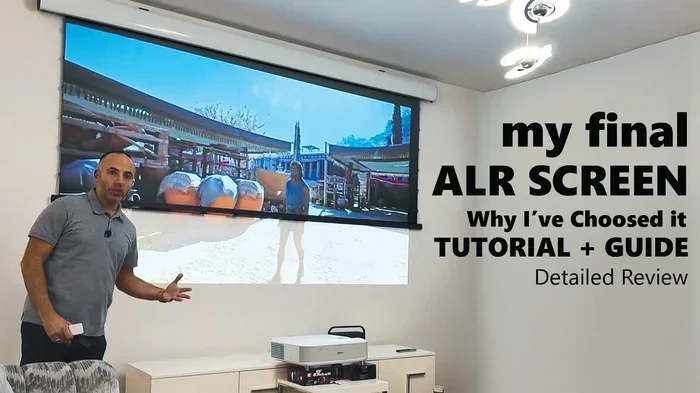
Fixed frame screens are mounted to the wall and stay up permanently. They are the best option for a dedicated home theater. The surface is perfectly flat, which gives the sharpest image possible. These screens look professional and sleek.
The downside is they are not portable. You cannot take them down easily or move them to another room. They also tend to be the most expensive option. If you are serious about home projection, though, a fixed frame screen is hard to beat.
Retractable Screens
Retractable screens roll up into a case when not in use. They are great for rooms that serve multiple purposes. You can roll the screen down for movie night and roll it back up when you need the wall for something else.
These screens are convenient and come in both ceiling-mounted and wall-mounted versions. The image quality is slightly lower than a fixed frame because the material is never perfectly taut. But for most people, the difference is barely noticeable.
Portable and Inflatable Screens
Portable screens are the budget-friendly option for people who project outdoors or move around a lot. Inflatable screens are especially popular for backyard movie nights. You can set one up in minutes and take it down just as fast.
The image quality on inflatable screens is not as sharp as a fixed screen. The surface can wrinkle and the material is thinner. But for casual fun with friends and family, they work great. Plus, they are a lot of fun to use.
Room Lighting and Its Impact on Your Screen Choice
One factor that affects everything about projection is room lighting. The amount of light in your room determines how well your image looks and whether you need a screen at all.
Dark Rooms
In a dark room, almost any surface works well. A wall, a sheet, or a screen all produce a clear, bright image. This is because there is no competing light to wash out the projection. If you are projecting in a basement, a bedroom at night, or a room with blackout curtains, you have a lot of flexibility.
In a dark room, you can even get away with a slightly textured wall. The lack of ambient light means the imperfections are less visible. This is why many people start with just a wall and upgrade later if they want better quality.
Bright Rooms
If your room has windows or bright overhead lights, a screen becomes much more important. Ambient light washes out the projected image, making it look faded and washed out. A high-gain screen helps by reflecting more light back to the viewer, fighting off the ambient light.
In bright rooms, you also want to consider the screen material carefully. Some screens are designed specifically for bright environments. They have a higher gain and a narrower viewing angle, which keeps the image bright even when some light is coming from the sides. If you are projecting in a living room during the day, invest in a screen designed for this purpose.
Common Mistakes People Make With Projector Screens
Before you buy or build a screen, let us talk about some common mistakes. Avoiding these will save you time, money, and frustration.
Choosing the Wrong Screen Size
Too many people buy a screen that is too small. They think it will look fine, but once they see the image on a bigger surface, they kick themselves. Measure your room first. Consider the projector’s throw distance, which is how far the projector needs to be from the screen to produce a clear image. A screen that is too small makes the image feel cramped. One that is too large can look pixelated if the projector does not have enough resolution.
Ignoring Aspect Ratio
If your projector outputs a 16:9 image and your screen is a different ratio, you will see black bars on the sides or top and bottom. This is annoying and wastes part of your screen. Always match your screen aspect ratio to your projector’s native resolution. Most modern projectors use 16:9, so that is the safest choice.
Not Considering Gain
Gain is a measure of how much light a screen reflects back. A higher gain means a brighter image, but it also narrows the viewing angle. If you sit off to the side, the image might look dimmer or shift in color. For most home setups, a gain between 1.0 and 1.2 is ideal. It gives a bright image without sacrificing viewing angles.
Skipping the Test
Before you commit to a permanent setup, test your projector on different surfaces. Project onto your wall, a sheet, and a piece of white poster board. Compare the results. This costs nothing and gives you a much better idea of what works in your specific room. It also helps you decide whether a screen is truly worth the investment.
Can You Use a Projector Without a Screen for Outdoor Events
Outdoor projection is a lot of fun. Movie nights in the backyard, sports viewing on a big screen, or even a DIY drive-in theater. But can you project outdoors without a screen? Yes, you can. A white wall, a fence, or even a large white tarp works outdoors.
The challenge outdoors is ambient light. During the day, the sun washes out the image completely. You need a dark environment, which means evening or nighttime projection. Even then, streetlights or porch lights can reduce image quality. A screen helps by focusing the light back toward the viewers, making the image brighter and more visible.
If you are planning outdoor projection, consider an inflatable screen or a portable tripod screen. They are easy to set up and take down. You can also project onto a white bedsheet stretched between two trees. Just make sure it is pulled tight to minimize wrinkles.
For a fun outdoor setup, you can also try using a projector instead of a TV for a more immersive backyard experience. Pair it with a portable screen and some string lights, and you have an instant outdoor cinema.
Do You Need a Screen for a Projector With a Smartphone
More and more people are projecting from their phones. Whether you are sharing photos, watching YouTube, or giving a presentation, phone projection is incredibly convenient. But does projecting from a phone change whether you need a screen?
The answer is no. The same rules apply. A wall works, a sheet works, and a screen works best. If you want to mirror your iPhone to a projector, the screen you use will affect how the image looks just the same. A smooth white surface gives you the clearest picture from a phone too.
Phone projectors tend to be smaller and less bright than traditional projectors. This means the surface you project onto matters even more. A dedicated screen with a higher gain can make a noticeable difference when using a phone projector. It amplifies the limited brightness and gives you a better image.
Maintenance Tips for Your Projector Screen
If you invest in a projector screen, you want it to last. Proper care keeps the image looking great and extends the life of the material.
- Dust regularly. Use a soft microfiber cloth to gently wipe the surface. Do not use cleaning chemicals unless the manufacturer recommends them.
- Store portable screens properly. Roll them up gently and store them in a cool, dry place. Folding them creates creases that are hard to remove.
- Check for wrinkles. Even small wrinkles distort the image. Smooth them out before each use.
- Keep it away from moisture. Water damage can warp the material and affect the image. Do not set up a screen in damp areas.
- Replace when needed. Over time, screens can fade or stain. If the image starts looking dull, it might be time for a new screen.
Taking care of your screen is simple, but it makes a big difference. A well-maintained screen lasts for years and keeps your image looking sharp.
Final Verdict: Do You Need A Screen For A Projector
So, do you need a screen for a projector? The final answer depends on your situation. If you are projecting occasionally in a dark room and have a smooth white wall, you probably do not need a screen. A wall or a bedsheet will work just fine.
But if you watch movies regularly, care about image quality, or project in a room with some light, a screen is a smart investment. It improves brightness, contrast, color accuracy, and overall viewing comfort. The difference is real and easy to notice.
Start with what you have. Try projecting onto your wall. If it looks good enough for you, great. If you want more, consider a simple portable screen or a DIY solution. You can always upgrade later. The most important thing is to just start projecting and enjoy the experience.
Remember, the best setup is the one that works for you. Do not let perfection be the enemy of fun. Grab your projector, find a wall or a screen, and enjoy the show.
For more tips on getting the most out of your projector, check out how to replace your projector lamp with LED for longer-lasting and brighter projection.
Frequently Asked Questions
Can I project onto a wall without a screen?
Yes, absolutely. A smooth white wall works as a projection surface in most cases. The image might not be as sharp or bright as on a dedicated screen, but it gets the job done. This is the most common DIY solution for people who do not want to buy a screen.
What is the best DIY projector screen?
A white bedsheet stretched tightly on a wall is the most popular DIY option. You can also use a piece of white poster board, a white tarp, or even paint your wall with flat white projection paint. The smoother and whiter the surface, the better the image will look.
Does a projector screen make a big difference?
Yes, a projector screen makes a noticeable difference. It improves brightness, contrast, color accuracy, and image uniformity. If you watch movies or give presentations regularly, a screen is well worth the investment. But for casual, occasional use, a wall works just fine.
Can I use a projector outdoors without a screen?
You can project onto a white wall, fence, or tarp outdoors. However, outdoor projection works best at night when there is less ambient light. A portable screen or inflatable screen helps make the image brighter and more visible, especially if there is any nearby light pollution.
How do I choose the right projector screen size?
Measure your room and consider your projector’s throw distance. The throw distance is how far the projector needs to be from the screen to produce a clear image. A screen that is too small makes the image feel cramped, while one that is too large can look pixelated if your projector does not have enough resolution. Most people find a 100-inch diagonal screen to be a good starting point.
Is a portable screen worth it?
Yes, portable screens are worth it if you move your projector around or project outdoors. They are affordable, lightweight, and set up in seconds. While they do not match the image quality of a fixed frame screen, they are a great compromise between convenience and performance.