Can I Use Hdmi 1 And 2 At The Same Time On My Tv Setup
Yes, you can absolutely use HDMI 1 and 2 at the same time on most modern TVs. This allows you to run multiple source devices simultaneously, such as a gaming console on one port and a streaming box on another. Understanding how your TV handles multiple HDMI inputs helps you get the most out of your home entertainment setup.
Key Takeaways
- Multiple HDMI ports work simultaneously: Your TV can display different content on each input when using HDMI 1 and 2 at the same time.
- No special equipment is needed: Most modern TVs handle multiple active HDMI inputs without extra hardware.
- You may need an HDMI switch or splitter: If your TV only has one output, these devices help manage multiple sources.
- Check your TV’s capabilities: Not all TVs support picture-in-picture or multi-view features for dual HDMI inputs.
- HDMI version matters: Using HDMI 2.0 or 2.1 ports ensures you get the best resolution and refresh rates.
📑 Table of Contents
- Can I Use HDMI 1 And 2 At The Same Time On My TV Setup?
- How HDMI Ports Work on Modern TVs
- Using Multiple HDMI Devices Simultaneously
- Can You Display Two HDMI Inputs at Once?
- Setting Up Your TV for Dual HDMI Use
- Common Mistakes When Using Multiple HDMI Ports
- HDMI 1 vs HDMI 2: Are There Any Differences?
- Expert Insights on Maximizing Your HDMI Setup
- Key Takeaways
- Conclusion
Can I Use HDMI 1 And 2 At The Same Time On My TV Setup?
Let’s get straight to the point. Yes, you can use HDMI 1 and 2 at the same time on most television sets today. Whether you want to plug in a gaming console on one port and a streaming device on another, modern TVs are built to handle this with ease. But the full answer depends on a few factors that we will walk through in this guide.
Many people assume that using two HDMI ports at once requires special equipment or technical know-how. That is simply not true. Your TV was designed to accept multiple input signals simultaneously. The real question is what you want to do with those inputs and how your specific TV handles them. This guide breaks everything down in simple terms so you can set up your entertainment system with confidence.
We will cover how dual HDMI inputs work, when you might need extra hardware, and common mistakes that trip people up. By the end, you will have a clear picture of exactly what your TV can do. Let us dive in.
How HDMI Ports Work on Modern TVs
HDMI stands for High-Definition Multimedia Interface. It is the standard cable that carries both video and audio through a single cord. Every modern TV comes with at least two HDMI ports, and many models offer three, four, or even more. Each port acts as an independent input channel. This means each one can receive a separate signal from a different device.
When you connect a device to HDMI 1 and another to HDMI 2, your TV treats them as separate sources. You can switch between them using your remote or the TV’s input menu. Some TVs allow you to view both inputs at the same time, which opens up even more possibilities for your setup.
The Role of HDMI Ports in Signal Transmission
Each HDMI port on your TV handles a dedicated data stream. Think of it like a dedicated lane on a highway. When you use HDMI 1 and HDMI 2 together, each port carries its own lane of video and audio data. They do not interfere with each other. This is why you can have a cable box running on HDMI 1 while a Blu-ray player sits on HDMI 2, and both remain ready to use.
The quality of the signal depends on the HDMI version your ports support. HDMI 1.4, HDMI 2.0, and HDMI 2.1 each offer different capabilities. Newer versions support higher resolutions like 4K and even 8K, along with faster refresh rates. When shopping for cables or devices, always check which HDMI version your ports use.
Understanding HDMI Versions and Compatibility
Not all HDMI ports are created equal. Here is a quick breakdown of what each version brings to the table:
- HDMI 1.4: Supports 4K at 30Hz. Good for basic 4K content and most streaming needs.
- HDMI 2.0: Supports 4K at 60Hz. Great for smooth gaming and high-quality video playback.
- HDMI 2.1: Supports up to 8K at 120Hz. The latest standard for ultra-high-definition content.
When you are using HDMI 1 and 2 at the same time, both ports should ideally be the same version. This ensures consistent performance across all your connected devices. If one port is HDMI 2.0 and the other is HDMI 1.4, the lower version will limit the output for that particular device.
Using Multiple HDMI Devices Simultaneously
Running multiple devices on different HDMI ports is the most common reason people ask this question. Maybe you have a PlayStation on HDMI 1, a Roku on HDMI 2, and a soundbar connected through ARC. All of these can work at the same time without any problem.
The key thing to understand is that your TV can only display one input at a time on the main screen. However, all devices remain powered and ready. You simply switch between them using your remote. Some TVs offer picture-in-picture or split-screen features that let you view two inputs at once. We will get into that shortly.
Common Devices Connected to Multiple HDMI Ports
Here are the most common devices people connect to different HDMI ports:
- Gaming consoles: PlayStation, Xbox, or Nintendo Switch on one port.
- Streaming devices: Roku, Amazon Fire Stick, or Apple TV on another.
- Cable or satellite boxes: For live TV channels.
- Blu-ray players: For high-quality movie playback.
- AV receivers: For home theater audio processing.
Having all these devices connected and ready is incredibly convenient. You do not need to unplug and replug cables every time you want to switch activities. Just press a button on your remote and jump from gaming to streaming in seconds.
Can You Display Two HDMI Inputs at Once?
This is where things get interesting. While your TV can accept signals from HDMI 1 and 2 simultaneously, displaying them both at the same time depends on your TV’s features. Not every model supports multi-view or picture-in-picture mode.
Higher-end TVs from brands like Samsung, LG, and Sony often include split-screen features. These let you watch one input in a main window and another in a smaller sidebar. Some models even allow you to divide the screen into two equal halves. This is perfect for watching a live sports game while keeping a streaming show running in the background.
Picture-in-Picture and Multi-View Features
Picture-in-picture (PiP) is the most common way to view two HDMI inputs at once. The main screen shows one source, while a smaller window in the corner displays the second source. You can usually resize and reposition the smaller window using your TV remote.
Multi-view takes this a step further. Instead of one main screen and one small window, multi-view splits the display into multiple sections. Some TVs offer a 2×2 grid that shows four different inputs at once. This is fantastic for sports fans who want to track multiple games simultaneously.
Keep in mind that these features work best when both HDMI ports support the same resolution. If HDMI 1 is running 4K and HDMI 2 is running 1080p, the display quality on the smaller window may drop. Always check your TV’s user manual for specific PiP and multi-view requirements.
When Your TV Does Not Support Multi-View
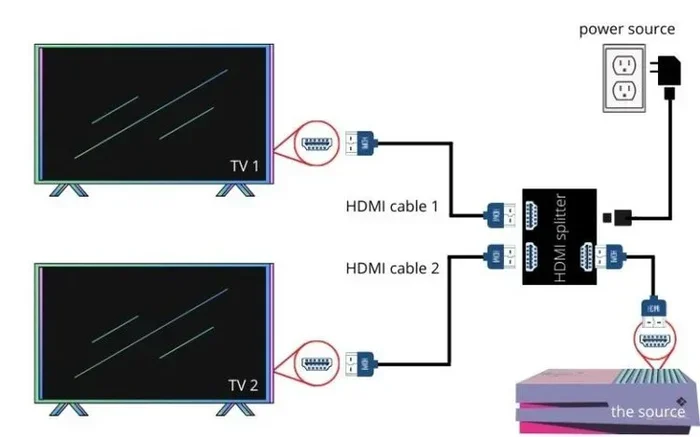
If your TV lacks picture-in-picture or multi-view capabilities, do not worry. You still have options. One popular workaround is using an external HDMI switch or splitter. These small devices let you manage multiple inputs more flexibly.
An HDMI switch lets you connect multiple devices to a single TV port. You toggle between them using the switch or a remote. An HDMI splitter takes one input and sends it to multiple screens. This is useful if you want the same content on two TVs in different rooms.
For a more advanced setup, consider an AV receiver. These devices act as a central hub for all your audio and video equipment. They handle HDMI switching, audio processing, and often support the latest HDMI standards like eARC and Dolby Atmos. A good AV receiver can really elevate your home theater experience.
Setting Up Your TV for Dual HDMI Use
Getting the most out of your HDMI 1 and HDMI 2 ports is easier than you might think. Follow these steps to set up a clean, efficient dual-input configuration.
Step-by-Step Setup Guide
- Identify your devices: Decide which devices you want on each port. Put your most frequently used device on HDMI 1 for quick access.
- Check port versions: Look at the labels near each HDMI port on the back of your TV. Note the HDMI version if listed. Match your devices to the best available ports.
- Connect your devices: Plug each device into its designated port using a quality HDMI cable.
- Power on and test: Turn on each device one at a time and switch to the corresponding input on your TV. Verify that both video and audio work correctly.
- Configure display settings: Go into your TV’s settings menu and adjust resolution, refresh rate, and audio output for each input as needed.
Quick Tips for the Best Performance
Here are some pro tips that make a real difference in your daily use:
- Use high-speed HDMI cables rated for 4K or 8K to get the best picture quality.
- Label your HDMI ports with small stickers so everyone in the house knows which device goes where.
- Keep your TV firmware updated to ensure full compatibility with all connected devices.
- Use the HDMI-CEC feature (called different names by different brands) to let all devices control your TV with one remote.
- Store excess cable length neatly to avoid tangles and keep your entertainment area clean.
Common Mistakes When Using Multiple HDMI Ports
Even with the best intentions, people make avoidable mistakes when setting up multiple HDMI devices. Here are the most common ones and how to fix them.
Using the Wrong HDMI Cable
Not all HDMI cables are the same. Using an older HDMI 1.4 cable with an HDMI 2.1 device can limit your resolution and refresh rate. Always match your cable to the highest capability of your devices. A cheap, low-quality cable can also cause signal drops and audio sync issues.
Ignoring HDMI-CEC Settings
HDMI-CEC (Consumer Electronics Control) lets connected devices talk to each other. For example, turning on your TV can automatically power on your streaming box. Many people leave this feature off, missing out on a much smoother user experience. Check your TV settings and enable HDMI-CEC under the appropriate name for your brand.
Overloading a Single HDMI Port
Some people try to connect too many devices to a single port using cheap splitters or adapters. This can degrade the signal and cause display problems. Each HDMI port is designed to handle one direct connection. If you need more ports, use a powered HDMI switch instead of a passive splitter.
It is also worth noting that your TV’s internal hardware handles the input switching. The way your TV processes these signals can sometimes be compared to how a computer’s motherboard manages its various ports and components. Just as a motherboard has specific slots for different functions, your TV has dedicated HDMI ports for specific input handling. If you are curious about what components make up the hardware inside your devices, you might find this breakdown of motherboard components interesting and helpful for understanding how internal connections work.
HDMI 1 vs HDMI 2: Are There Any Differences?
In most cases, HDMI 1 and HDMI 2 on your TV are identical in capability. They are simply two separate input channels that happen to be labeled differently. However, there are a few scenarios where the two ports might differ.
Some TVs designate one port as an eARC (enhanced Audio Return Channel) port. This port is optimized for sending high-quality audio back to a soundbar or AV receiver. Another common difference is that one port might be HDMI 2.1 while the other is HDMI 2.0. This matters if you are connecting a next-gen gaming console that benefits from the higher bandwidth of HDMI 2.1.
When setting up your TV, always check which port offers the best features for each device. Plug your PlayStation 5 or Xbox Series X into the HDMI 2.1 port if available. Use standard HDMI 2.0 ports for streaming devices and cable boxes that do not need the extra bandwidth.
Security-conscious users should also be aware that smart TVs with multiple network-connected HDMI ports can be vulnerable to certain types of digital attacks. For more information on how to protect your connected devices, consider reading about the advantages and disadvantages of MAC address filtering as an additional layer of network security for your home setup.
Expert Insights on Maximizing Your HDMI Setup
We asked home theater enthusiasts and tech professionals for their top tips on getting the most from multiple HDMI ports. Here is what they had to say.
Prioritize your gaming ports. If you are a serious gamer, always use the HDMI 2.1 port for your console. The higher bandwidth means lower input lag and smoother gameplay. You will notice the difference, especially in fast-paced titles.
Label everything. It sounds simple, but taking five minutes to label your HDMI ports and cables saves hours of confusion later. Use small pieces of tape or a label maker. Your future self will thank you.
Keep a spare HDMI cable handy. Cables fail more often than people expect. Having a backup cable in your entertainment center means you are never stuck without a working connection.
Update your devices regularly. Firmware updates for your TV, gaming console, and streaming devices often include fixes for HDMI handshake issues. A simple restart after an update can resolve many connectivity problems.
Key Takeaways
- Multiple HDMI ports work simultaneously: Your TV can accept and process signals from HDMI 1 and 2 at the same time without any issues.
- Displaying both inputs at once depends on your TV: Picture-in-picture and multi-view features vary by model and brand.
- HDMI version compatibility matters: Match your cables and devices to the HDMI version of each port for the best results.
- Extra hardware can expand your options: HDMI switches, splitters, and AV receivers give you more flexibility when ports are limited.
- Avoid common setup mistakes: Use the right cables, enable HDMI-CEC, and never overload a single port with too many devices.
- Label and organize your connections: A clean setup reduces frustration and makes switching between devices effortless.
Conclusion
So, can you use HDMI 1 and 2 at the same time? The answer is a resounding yes. Your TV is built to handle multiple active HDMI inputs, and using them together is one of the simplest ways to get more out of your entertainment setup. Whether you are gaming, streaming, or watching live TV, having multiple devices connected and ready to go is incredibly convenient.
The key is understanding your TV’s capabilities and setting things up correctly. Use the right cables, take advantage of features like picture-in-picture if your TV supports them, and keep your devices updated. With these simple steps, your dual-HDMI setup will serve you well for years to come.
Do not overthink it. Plug in your devices, switch between inputs, and enjoy the seamless experience that modern HDMI technology provides. Your TV was designed for exactly this kind of use, and now you know exactly how to make the most of it.
Frequently Asked Questions
Can I use HDMI 1 and HDMI 2 for different resolutions at the same time?
Yes, you can. Each HDMI port operates independently and can handle a different resolution. For example, you can have a 4K device on HDMI 1 and a 1080p device on HDMI 2. The TV will display the resolution that matches the active input signal.
Do I need a special HDMI switch to use two ports at once?
No, you do not need any special equipment to use HDMI 1 and 2 simultaneously. Your TV handles multiple active inputs by default. You only need an HDMI switch if you want to connect more devices than your TV has available ports.
Will using two HDMI ports slow down my TV’s performance?
Absolutely not. Modern TVs are designed to manage multiple input channels without any performance loss. The TV simply processes each input independently, so having two or more devices connected does not affect speed or picture quality.
Can I record from one HDMI input while watching another?
This depends on your TV and any external recording equipment you own. Most standard TVs do not support simultaneous recording and viewing from different inputs. However, an external DVR or capture card connected via HDMI can enable this functionality.
What should I do if my TV does not recognize both HDMI inputs?
First, try unplugging and replugging the HDMI cables firmly. If the issue persists, check your TV’s firmware for updates. You can also try a different HDMI cable or test the device on another TV to rule out a faulty cable or device.
Is it safe to leave multiple HDMI devices powered on all the time?
Yes, it is generally safe. Most modern TVs and HDMI devices are designed for continuous use. However, if you are concerned about energy consumption or device longevity, you can use your TV’s standby mode or a smart power strip to manage power efficiently.
=== META TITLE ===
Can I Use HDMI 1 and 2 At The Same Time On My TV Setup?
=== URL SLUG ===
can-i-use-hdmi-1-and-2-at-the-same-time-on-my-tv-setup